The light we cannot lose

On this World News Day, for too many people, the future is getting too dark to see. This moment is best described as living in a state of perpetual flux, of global uncertainty and deep, unsettling insecurity.

On this World News Day, for too many people, the future is getting too dark to see. This moment is best described as living in a state of perpetual flux, of global uncertainty and deep, unsettling insecurity.
A protester in front of a police cordon

Fear as strategy and Europe’s Passivity: How Global Media Describe the Situation in Serbia

From admiration for the student movement to criticism of nationalist symbols during the Vidovdan protest, foreign media coverage of events in Serbia since November 1 of last year has gone through different phases. Judging by the latest headlines, however, autocrat Aleksandar Vučić is running out of room to maneuver. The country he leads is sinking deeper into chaos, and Europe is being urged to increase pressure on his regime in Belgrade.

From admiration for the student movement to criticism of nationalist symbols during the Vidovdan protest, foreign media coverage of events in Serbia since November 1 of last year has gone through different phases. Judging by the latest headlines, however, autocrat Aleksandar Vučić is running out of room to maneuver. The country he leads is sinking deeper into chaos, and Europe is being urged to increase pressure on his regime in Belgrade.

Manufacturing consent or apathy? Digital media and public opinion in Serbia

Bots, trolls and cyber troops are means of political elites to manipulate public opinion and manufacture political apathy

Bots, trolls and cyber troops are means of political elites to manipulate public opinion and manufacture political apathy

Tatlin's Tower, the project for the Monument to the Third International; Photo: Aurelien Guichard / Flickr

An internationalist collective endeavor in times of rising instability: discussing the Eastern European Left Media Network

How much do we Eastern Europeans know about each other? What kind of information can we acquire about each others' local context? Where is this information produced, in what language and based on what political views and underlying ideologies?

How much do we Eastern Europeans know about each other? What kind of information can we acquire about each others’ local context? Where is this information produced, in what language and based on what political views and underlying ideologies?

Sarah Leonard: Developing sharp, well-informed leftists is as important a role for magazines as publishing left ideas

Sarah Leonard is a journalist and editor of several left-leaning magazines and online magazines, which are becoming more and more common in the United States. Together with Bhaskar Sunkara, she edited a collection of essays entitled: "The Future We Want: Radical Ideas for the New Century". We met Sarah in Belgrade last year on her journey through Southeast Europe, and we renewed the conversation during the past few months marked by the coronavirus pandemic.

Sarah Leonard is a journalist and editor of several left-leaning magazines and online magazines, which are becoming more and more common in the United States. Together with Bhaskar Sunkara, she edited a collection of essays entitled: “The Future We Want: Radical Ideas for the New Century”. We met Sarah in Belgrade last year on her journey through Southeast Europe, and we renewed the conversation during the past few months marked by the coronavirus pandemic.

Protest against layoffs in Radio-Television of Vojvodina

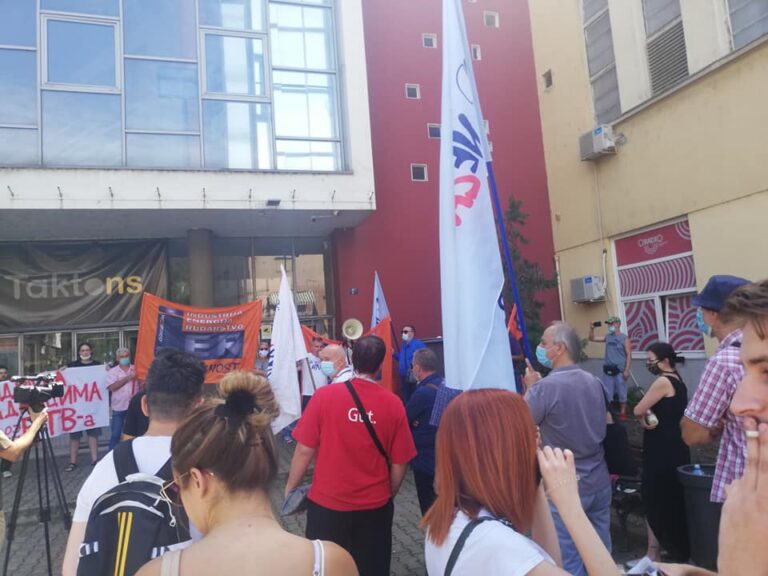
A protest against the announced dismissal of 200 workers of the Radio-Television of Vojvodina, who have been hired through an employment agency, was held today at noon in front of Studio M in Novi Sad.

A protest against the announced dismissal of 200 workers of the Radio-Television of Vojvodina, who have been hired through an employment agency, was held today at noon in front of Studio M in Novi Sad.

The Independent Journalists’ Association of Serbia awarded Mašina with a special plaque for coverage of workers’ rights in Serbia

Mašina was awarded a special plaque by the Independent Journalists’ Association of Serbia (NUNS) “for an innovative approach to investigative journalism and coverage of the topic of workers’ rights in Serbia”, as it was said at the ceremony. The plaque was also awarded to the editorial board of Južne vesti, while the awards for investigative journalism were given to colleagues: Adam Santovac, Aleksandar Đorđević, Jelena Veljković and Vuk Cvijić.